


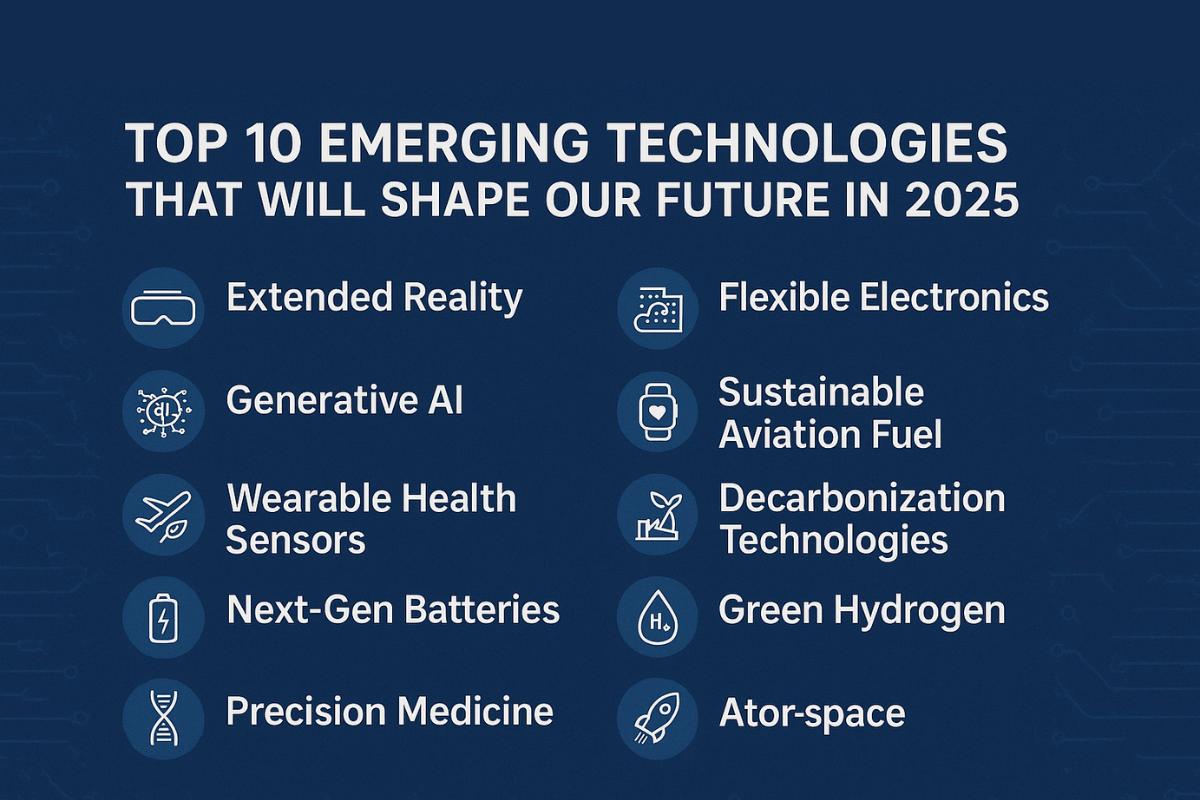
Technology evolves at an unprecedented pace, redefining the way we live, work, and interact with the world. By 2025, emerging technologies are expected to reshape industries, revolutionize everyday life, and create new opportunities and challenges. In this blog, we explore the top 10 emerging technologies that are set to make a significant impact in the coming years.
1. Artificial Intelligence (AI) and Machine Learning (ML)
Artificial Intelligence (AI) and Machine Learning (ML) continue to be at the forefront of technological innovation. By 2025, AI is expected to become even more sophisticated, enabling machines to make complex decisions, predict outcomes, and perform tasks that once required human intelligence. AI applications range from healthcare and finance to autonomous vehicles and smart cities. ML, a subset of AI, allows systems to learn from data patterns and improve performance over time, driving efficiency and innovation across sectors.
2. Emerging Technologies Overview Table
| Technology | Description | Potential Impact | Example Applications |
|---|---|---|---|
| Artificial Intelligence (AI) & Machine Learning (ML) | Advanced algorithms enabling machines to mimic human intelligence | Improved decision-making, automation, personalized experiences | Autonomous vehicles, virtual assistants, predictive analytics |
| Quantum Computing | Computing based on quantum bits (qubits) | Solving complex problems faster than classical computers | Drug discovery, cryptography, climate modeling |
| 5G & 6G Connectivity | Next-generation mobile networks | Ultra-fast, low-latency connectivity for devices | Smart cities, IoT, augmented reality |
| Internet of Things (IoT) | Network of connected devices exchanging data | Automation, data-driven insights, improved efficiency | Smart homes, industrial automation, healthcare monitoring |
| Blockchain & Decentralized Finance (DeFi) | Distributed ledger technology for secure transactions | Enhanced security, transparency, and decentralized control | Cryptocurrencies, supply chain management, digital identity |
| Augmented Reality (AR) & Virtual Reality (VR) | Immersive digital experiences | Enhanced visualization, remote collaboration, entertainment | Gaming, virtual training, remote meetings |
| Robotics & Automation | Machines performing human-like tasks | Increased productivity, precision, and safety | Manufacturing, logistics, healthcare surgeries |
| Biotechnology & Genomics | Advanced manipulation of biological systems | Improved healthcare, personalized medicine | Gene therapy, regenerative medicine, synthetic biology |
| Renewable Energy & Energy Storage | Sustainable energy solutions | Reduced carbon footprint, energy independence | Solar power, wind energy, advanced batteries |
| Cybersecurity & Privacy Tech | Protection of digital assets and personal data | Safer digital environments, trust in technology | AI-driven threat detection, encryption, identity management |
3. Quantum Computing
Quantum computing represents a radical shift from traditional computing. Unlike classical computers that use bits as 0s and 1s, quantum computers use qubits, which can represent both 0 and 1 simultaneously. This allows quantum computers to process vast amounts of data and perform calculations at speeds unattainable by classical machines. By 2025, quantum computing is expected to impact fields like cryptography, drug discovery, and climate research, enabling breakthroughs previously considered impossible.
4. 5G and 6G Connectivity
The rollout of 5G networks is already transforming communication by providing faster data transfer rates, lower latency, and more reliable connections. By 2025, 6G technology will begin emerging, promising even higher speeds, real-time connectivity, and advanced features like holographic communication. These technologies will fuel smart cities, autonomous vehicles, and massive Internet of Things (IoT) networks, creating a hyper-connected world.
5. Internet of Things (IoT)
The Internet of Things (IoT) refers to a network of interconnected devices capable of collecting and exchanging data. IoT has applications in smart homes, industrial automation, healthcare, and agriculture. By 2025, IoT devices will become even more intelligent, providing predictive maintenance, optimizing energy usage, and enabling seamless interaction between humans and machines.
6. Blockchain and Decentralized Finance (DeFi)
Blockchain technology offers secure, transparent, and tamper-proof solutions for digital transactions. It underpins the growth of decentralized finance (DeFi), enabling peer-to-peer financial transactions without intermediaries. By 2025, blockchain will extend beyond cryptocurrency, impacting supply chains, healthcare records, voting systems, and identity management, ensuring security and trust in digital interactions.
7. Augmented Reality (AR) and Virtual Reality (VR)
AR and VR are transforming the way we experience the digital world. AR overlays digital content on the physical world, while VR creates entirely immersive environments. These technologies are increasingly used in gaming, remote collaboration, virtual training, and healthcare. By 2025, AR and VR are expected to redefine education, entertainment, and workplace experiences with more interactive and realistic simulations.
8. Robotics and Automation
Robotics and automation technologies are enhancing productivity, precision, and safety across industries. Robots can perform repetitive, dangerous, or highly technical tasks efficiently. In sectors like manufacturing, healthcare, and logistics, automation reduces human error and operational costs. By 2025, advancements in AI-powered robotics will enable more autonomous operations, including surgical robots, warehouse automation, and advanced personal assistants.
9. Biotechnology and Genomics
Biotechnology and genomics are revolutionizing healthcare and agriculture. Innovations in gene editing, synthetic biology, and personalized medicine allow targeted treatments, disease prevention, and enhanced crop production. By 2025, we can expect breakthroughs in regenerative medicine, gene therapy, and bioengineered solutions addressing global health and food security challenges.
10. Renewable Energy and Energy Storage
The push for sustainability is driving innovations in renewable energy and energy storage. Solar, wind, and other clean energy sources are becoming more efficient and affordable. Advanced batteries and energy storage solutions ensure consistent power supply even when generation fluctuates. By 2025, renewable energy technologies will play a central role in mitigating climate change and reducing reliance on fossil fuels.
11. Cybersecurity and Privacy Technology
As technology advances, so do cyber threats. Cybersecurity and privacy technologies are critical for protecting data and maintaining trust in digital systems. AI-driven threat detection, advanced encryption, and privacy-preserving solutions are key innovations. By 2025, these technologies will become more integrated into every device and platform, ensuring safer digital interactions and protecting sensitive information from cyber attacks.
Conclusion
The year 2025 promises a technological revolution across multiple sectors, driven by these emerging technologies. From AI and quantum computing to renewable energy and cybersecurity, these innovations will reshape how we live, work, and interact with our environment. Staying informed about these trends is crucial for individuals, businesses, and governments to harness their potential, adapt to change, and build a sustainable, technologically advanced future.
